Decentralized Finance is a term that may seem a bit complicated at first glance, but it is actually much simpler than it appears. In this guide, we will explain what is DeFi in the simplest way possible, and regardless of your level of knowledge in finance or crypto.
Key Takeaways
- DeFi leverages blockchain technology to offer peer-to-peer financial services that do not involve intermediaries.
- Smart contracts and oracles power DeFi applications. The first automates transactions securely, while the latter provides real-time data from external resources.
- DeFi Benefits include increased accessibility, transparency, and control, but also risks like volatility and security.
To properly understand what is DeFi, it is essential to understand the comparison CeFi vs DeFi (Centralized Finance vs Decentralized Finance).
CeFi vs DeFi
What is CeFi?
CeFi, or in other words, traditional finance as we know it, refers to the financial activities we carry out daily. These includedepositing or withdrawing money from a bank, sending or receiving money from friends or family, taking out a bank loan, or using an investment firm to manage our funds.
As you may notice, all these activities require the involvement of a third party or an intermediary, whether it is a bank, an investment firm, or another institution. This is where the concept of centralization in Centralized Finance comes from.
If tomorrow a bank or the government decides to freeze your funds for some reason, you will not be able to access or withdraw your money.
CeFi includes some crypto-related services, such as centralized cryptocurrency exchanges. These are online platforms like Binance or Coinbase, where you can trade cryptocurrencies. However, these platforms have full control over the funds you deposit, which is why they are classified in the CeFi category.
Therefore, not all crypto services are decentralized; only those that totally rely on blockchain technology are.
What is DeFi?
DeFi represents a financial ecosystem that allows users to conduct various financial activities directly with one another. Unlike centralized traditional finance, DeFi uses blockchain technology to eliminate the need for centralized intermediaries like banks, giving users full control over their assets.
Interesting Fact: The total value locked (TVL) in main DeFi platforms was at USD 166b back in October 2025. A much higher TVL is expected for the next few years as new DeFi platforms will emerge.
Comparison DeFi vs. CeFi
The following table outlines the key differences between DeFi and CeFi.
| Aspect | Centralized Finance (CeFi) | Decentralized Finance (DeFi) |
| Intermediaries | Uses banks or financial institutions for transactions. | Peer-to-peer with no intermediaries. |
| Accessibility | Requires permissions and identification checks. | No permissions or identification required |
| Transparency | Hidden from public view. | Transparent. Transactions are visible on the blockchain. |
| Control | Controlled by central authorities. | Users have full control over their assets. |
| Costs | Involves fees imposed by intermediaries. International transactions are very slow. | Generally lower fees and very fast transactions |
| Risks | More regulated, less risky | Dealing with unknown applications can be risky |
How DeFi Works
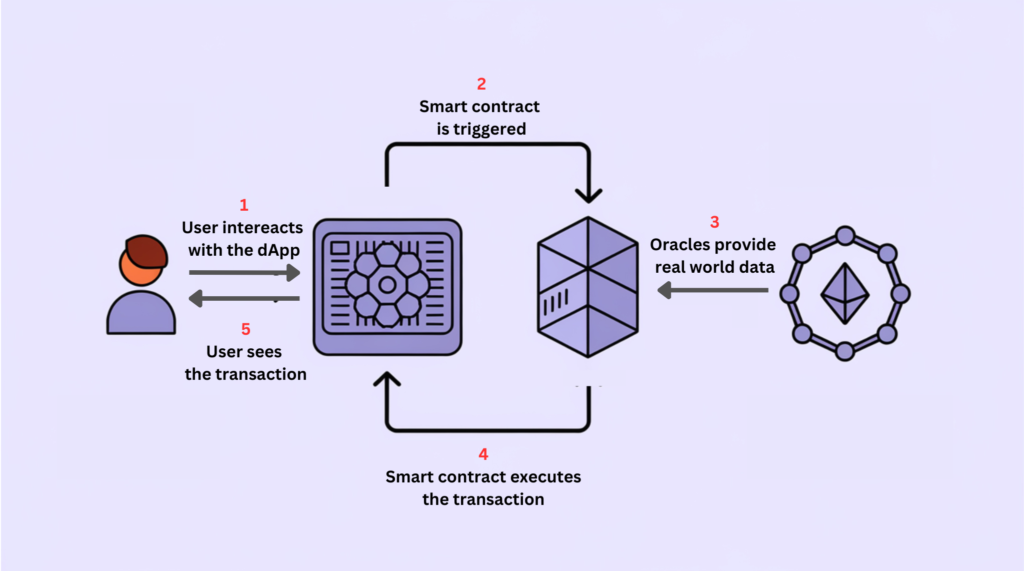
DeFi platforms use blockchain technology to eliminate the need for intermediaries. This is achieved through the complementarity and synergy between the three main components of DeFi.
- Smart contracts
- Oracles
- Decentralized applications, or dApps
1- Smart Contracts
Smart contracts are self-executing code on the blockchain that automatically enforces rules and executes transactions when specific conditions are met.
In Decentralized Finance, smart contracts enable everything from simple swaps to complex financial transactions without a middleman. This automated and transparent process reduces reliance on human trust and enhances security.
Example: Let’s say Eric is renting an apartment to Bryan. Eric creates a smart contract that automatically grants one-month access to the apartment’s digital lock once Bryan pays the monthly rent.
When Bryan sends the payment to the contract, it verifies the funds and sends them to Eric if the amount is correct. At the same time, it generates a digital key to give Bryan access to the apartment for the rental period without any further action from Eric.
2- Oracles in DeFi
Oracles are systems that provide real-time data to blockchain networks. Since blockchains can’t access external data independently, oracles enable DeFi applications to interact with real-world events. For instance, an oracle might provide asset prices to a DeFi protocol, allowing users to trade or leverage assets based on up-to-date market information.
3- dApps and Key DeFi Platforms
DeFi applications, or dApps, are blockchain-based applications that facilitate peer-to-peer financial services. While the two other DeFi components (smart contracts and oracles) operate in the background, dApps are what users see and interact with.
Here are some use cases of the top DeFi platforms:
- Token swaps: Uniswap is a decentralized exchange (DEX) that allows users to trade tokens directly without needing a centralized intermediary.
- Liquidity mining: Yearn Finance is a defi platform that rewards users for providing liquidity.
- DeFi Staking – Staking dApps enable users to earn rewards by locking up their assets to support the security and functionality of a blockchain network. For example, Stakefish allows users to earn staking rewards in exchange for helping validate transactions on networks like Ethereum 2.0
Token Swap Example – How Smart Contracts, Oracles and dApps Work Together
- Smart Contracts: When a user initiates a token swap on a decentralized exchange like Uniswap, a smart contract is triggered to handle the transaction. This smart contract contains the conditions of the swap: the amount, which token, recipient’s address, and price parameters. Once the user confirms the transaction, the smart contract is activated, holding the user’s tokens in escrow and preparing to exchange them based on the price data it receives from oracles.
- Oracles: To ensure that the swap is executed at a fair market rate, the smart contract relies on price data provided by oracles projects like Chainlink. These oracles fetch real-time price information from multiple external resources and feed this data into the smart contract. By sourcing reliable price data, oracles prevent token swaps from occurring at manipulated or outdated prices.
- dApps: The decentralized application (such as Uniswap’s interface) is the platform the users interact with. Through the dApp, users can select tokens, view real-time prices, and initiate swaps. The dApp is a bridge that connects the user to the smart contract on the blockchain, guiding them through the swap process and displaying real-time price updates from oracles.
Benefits of DeFi
As you’ve already noticed by now, DeFi brings multiple major benefits to the financial space, especially for individuals.
- Accessible and Transparent: DeFi relies on blockchain technology. This makes DeFi accessible to anyone with an internet connection; geographical and international borders do not matter anymore. Also, DeFi transactions are transparent and publicly recorded on the blockchain, which increases trust and accountability.
- Control: Unlike traditional finance, DeFi users fully own full their assets and decisions, which offers them more freedom to manage their finances.
- Lower Costs: DeFi often reduces transaction fees and speeds up processes because it eliminates intermediaries.
- Scalable: DeFi protocols can often interact with each other, allowing for complex financial strategies that combine multiple protocols. This opens the door to more financial innovations in the future.
Risks and Concerns of DeFi
While DeFi has many benefits, it also comes with its share of risks:
- Hacks and Vulnerabilities: Smart contracts are subject to bugs or errors leading to potential hacks and malicious attacks that often end up with users losing funds.
- Regulatory Uncertainty: The lack of regulatory oversight makes DeFi a potential target for future regulations, which could impact its functionality.
- Market Volatility: Unlike traditional finance, DeFi lacks a safety net, such as FDIC insurance, which could protect user funds.
Bottom Line
The DeFi ecosystem still needs to mature enough to dominate the financial landscape. On the bright side, it has already established itself as a serious option by providing a much-needed decentralized alternative to traditional finance. As a new technology, it is fair to say that potential DeFi benefits far exceed the risks and concerns associated with its use.