
Stablecoins‘ market cap has continued its remarkable expansion through 2025, with total market supply and transaction activity up sharply year-to-date. This reflects broader adoption across trading, payments, and institutional use cases.
According to recent data, the market capitalisation of stablecoins is up about 50% this year, underscoring their growing role in the crypto ecosystem.
Who’s Leading the Charge?
As of late 2025, the combined stablecoins market cap has crossed the $300 billion threshold, a milestone that consolidates their position as a cornerstone of digital finance.
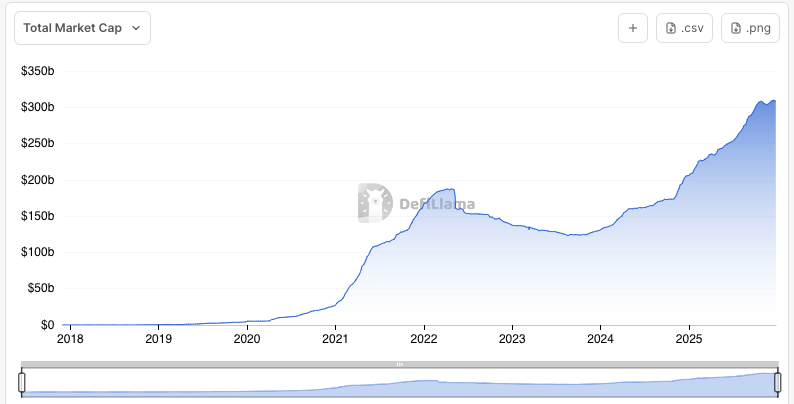
The metrics shown on Defillama’s stablecoin page show that the dominance remains focused around a handful of major players. Tether (USDT) continues to hold the largest market share, accounting for around 60% of total stablecoin market cap.
Right behind is Circle’s USD Coin (USDC), which has seen significant growth, both in circulating supply (around 70%YTD) and usage, pushing its market cap to around $78 billion by end of 2025.
We also noted that the landscape is slowly diversifying. Emerging stablecoins like Ethena’s USDe, and newer entrants like USD1 have begun to carve out niche positions.
What Is Pushing This Growth?
Several key factors could explain this explosion in stablecoin adoption:
- Utility Beyond Trading: Stablecoins have moved far beyond being trading pairs on exchanges. Today, they are actively used for payments, settlements, corporate treasury operations, and cross-border transfers. These functions were once dominated by traditional banks and networks.
- Significant on-chain volume increase: On-chain data shows stablecoin transaction volumes hitting multi-trillion-dollar levels. Some reports noted an increase of 83% year-on-year in stablecoin transfer activity.
- Regulatory Clarity: 2025 saw important regulatory developments like the US GENIUS Act and stablecoin legislation in key global markets.
- Blockchain Integration: Stablecoins now operate across more blockchains than ever before increasing accessibility and lowering transaction costs.
Conclusion:
Stablecoins are no longer a cryptocurrency niche; they are becoming fundamental building blocks of digital finance.
With strong growth metrics, expanding use cases, and increased regulatory clarity, stablecoins could significantly reshape how value is transferred globally in the years to come.