If you’re new to crypto, learning how to avoid crypto scams is just as important as learning how to buy your first Bitcoin. The crypto space offers exciting opportunities, but it also attracts scammers looking to take advantage of beginners who are still learning how things work.
Crypto scams don’t always look obvious. Some appear professional, some sound helpful, and others create a sense of urgency that pushes people to make rushed decisions. Many victims don’t lose money because they’re careless, but because they simply didn’t know what to watch out for.
This guide walks you through 10 essential best practices to help you stay safe. By the end, you’ll have a much clearer idea of how to avoid crypto scams and protect your funds as a beginner.
1. Educate Yourself Before You Invest Anything
The first and most important rule of how to avoid crypto scams is simple: don’t rush in without understanding what you’re doing.
Many scams rely on confusion. If you don’t know how wallets work, what a seed phrase is, or how transactions are confirmed, it’s much easier for someone to mislead you. Even reading a few beginner guides can drastically reduce your risk.
If something sounds impressive but you don’t fully understand it, pause. Scammers often use technical jargon to sound legitimate and discourage questions.
If you use the X platform, you should follow some well-known accounts like ZachXBT, who regularly exposes cryptocurrency scams. This will allow you to stay up-to-date with the newest methods scammers are using.
2. Only Use Reliable and Well-Known Crypto Exchanges
As a beginner, you should stick to reputable crypto exchanges with a strong track record. These platforms are not perfect, but they usually follow security standards and offer basic protections.
Scammers often create fake exchanges or clone websites that look almost identical to popular platforms. You might be promised lower fees or exclusive bonuses, but once you deposit funds, they disappear.
Always double-check URLs, use official apps, and avoid exchanges you’ve never heard of, unless you’ve done thorough research.
3. Never Share Your Seed Phrase
Your seed phrase (also called recovery phrase) is the most sensitive piece of information in crypto. Anyone who has it has full access to your funds. No legitimate company, exchange, or support agent will ever ask for your seed phrase. If someone does, it’s a scam, every single time!
A common scenario: you ask for help online, and someone offers to “fix” your wallet issue if you share your recovery phrase. The moment you do, your funds are gone. Learning how to avoid crypto scams starts with treating your seed phrase like a vault key.
4. Use a Cold Wallet for Long-Term Storage
Keeping funds on an exchange may be convenient, but it also increases risk. For larger or long-term holdings, using a hardware wallet (cold wallet) is much safer.
Cold wallets store your private keys offline, making them nearly impossible to hack remotely. Even if your computer is compromised, your crypto remains protected.
Scammers often target beginners who keep everything in hot wallets or exchanges because it’s easier to exploit poor security habits.
5. Be Extremely Careful With Telegram and Discord
Some of the most common crypto scams happen on Telegram and Discord.
Here’s a typical situation: you join a project’s Telegram group and ask a question. Within minutes, you receive several direct messages from people pretending to be admins or support agents. They may have official-looking usernames and profile pictures.
If there is one thing to know about crypto telegram groups, it’s that real admins do not DM users first. Scammers will usually try to redirect you to fake websites or ask for wallet access. If you want to know how to avoid crypto scams, remember this rule: ignore unsolicited DMs.
6. Enable Two-Factor Authentication (2FA) Everywhere
Two-factor authentication adds an extra layer of security to your accounts. Even if someone gets your password, they still won’t be able to log in without the second verification step.
Always enable 2FA on exchanges, wallets, and email accounts linked to crypto. It is preferable to use app-based authenticators over SMS when possible, as the latter can be vulnerable to SIM-swapping attacks.
This simple step alone can prevent many common hacks and account takeovers.
7. Watch Out for “Guaranteed Profits”
If someone promises guaranteed returns, it’s a scam. Crypto markets are volatile, and no legitimate investment can guarantee profits. Scammers often create urgency by saying things like “last chance” or “today only”. This pressure is designed to stop you from thinking clearly.
When learning how to avoid crypto scams, remember: real opportunities don’t disappear in minutes, and legitimate projects don’t force you to act immediately.
8. Double-Check Websites, addresses, and Smart Contracts
Phishing scams are very common in crypto. Fake websites can look identical to real ones, with only a small spelling difference in the URL. Before connecting your wallet or signing any transaction, check the website address carefully. Bookmark official sites instead of clicking links from social media or DMs.
In some cases, scammers trick users into approving malicious smart contracts that drain wallets. If you don’t understand what you’re signing, don’t sign it.
Another scam method is the use of a poisoned address. The scammer sends you a tiny amount of crypto from an address that looks very similar to yours. Later, when you want to send funds again, you quickly copy the address from your past transactions, and you may accidentally copy the scammer’s address instead of your address, sending your funds directly to them. To avoid this type of crypto scam, always double-check the full wallet address before sending.
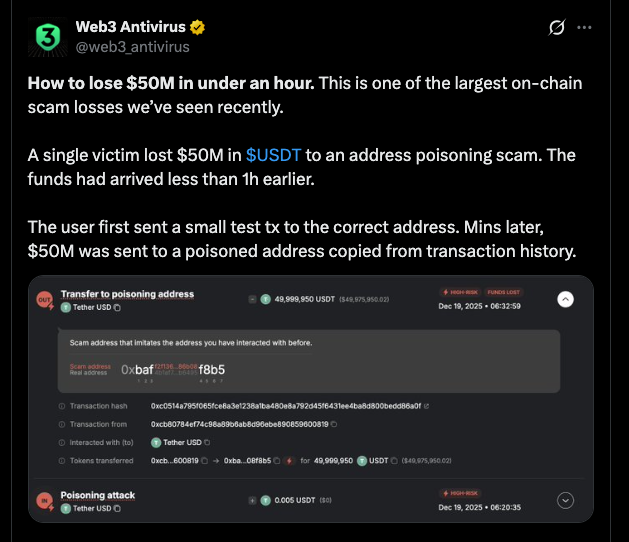
The screenshot above shows an example of a user who lost $ 50m worth of crypto to a poisoned address scam.
9. Start Small and Test Before Committing More Funds
One of the best practical ways to avoid crypto scams is to start with small amounts.
If you’re using a new platform, wallet, or protocol, test it with a small transaction first. This reduces potential losses if something goes wrong or turns out to be suspicious.
Beginners often lose money not because they made one big mistake, but because they trusted too much, too quickly.
10. Control Your Emotions
Finally, as with everything else in life, slow down. Scammers thrive on speed, excitement, and emotional decisions.
If something feels off, it probably is. It’s okay to step back, ask questions, and research before taking action. Crypto will still be there tomorrow.
Learning how to avoid crypto scams isn’t about being paranoid; it’s about being patient and informed.
Bottom Line
Crypto offers incredible innovation, but it also requires personal responsibility. Understanding how to avoid crypto scams is a crucial part of protecting your money, especially as a beginner.
By educating yourself, using trusted platforms, securing your wallets, and staying alert to common crypto scam tactics, you dramatically reduce your risk. Most scams succeed because of urgency, lack of knowledge, or misplaced trust, all things you can control.