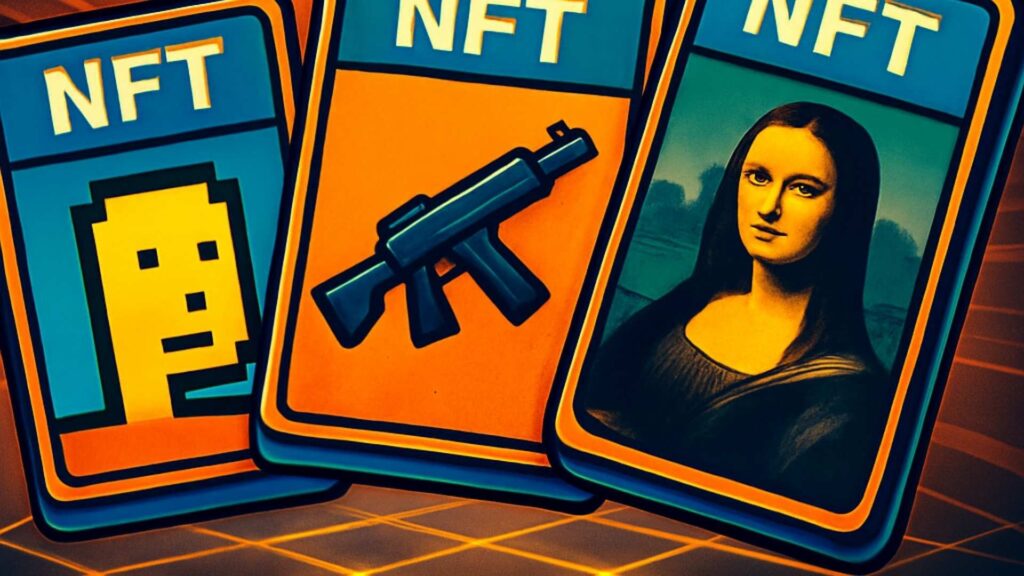
Back in 2021, NFTs were impossible to ignore. Digital images sold for millions of dollars, celebrities launched collections, and many newcomers rushed in without even understanding what is an NFT.
However, things look very different today. Prices, hype, and interest are much lower. This shift has led many people to ask an important question: Is the NFT market dead?
The reality is much more complex than a simple yes or no. NFTs did not disappear. Instead, the market went through a major correction, pushing out speculation and forcing the technology to evolve. In our guide “NFTs explained for dummies”, we’ll provide real-world examples to understand what NFTs are and their potential in the future.
What Is An NFT?
An NFT, or Non-Fungible Token, is a digital asset stored on a blockchain that represents ownership of something unique. Unlike cryptocurrencies such as Bitcoin or Ethereum, NFTs are not interchangeable. Each individual NFT has its own data, history, and value.
Let’s consider a simple real-world example of a dollar bill. It can be exchanged for any other dollar bill, it still has the same value. That’s because money is fungible. Now compare that to a concert ticket with a specific seat number or an original painting. Even if there are copies, only one version is the original. NFTs work similarly, but the data is stored on a blockchain.
When you own an NFT, you own proof of authenticity and ownership that can be verified publicly on the blockchain. That is the core idea behind NFTs.
How Do NFTs Work?
NFTs exist on blockchains, which are decentralized digital ledgers that record who created an NFT, who owns it, and every transaction it has gone through. As explained in our blockchain guide for beginners, this information is stored on thousands of computers, making it almost impossible to be altered.
This is where the difference between fungible and non-fungible tokens becomes important. Fungible tokens, like cryptocurrencies, are identical and fractionable. Non-fungible tokens are unique and cannot be replaced by another token of the same type.
The hype around NFTs came from the fact that they introduced true digital ownership. For the first time, creators could sell digital works with built-in royalties, and buyers could prove ownership without relying on a central authority. This opened the door to new business models in art, gaming, entertainment, and many other communities.
NFTs are now used for digital art, in-game items, virtual land, event tickets, and brand loyalty programs. While these use cases didn’t get the success many expected, they continue to grow slowly but surely.
How To Create an NFT and Enter the NFT Market
Creating an NFT is easier today than it was a few years ago. The NFT creation process usually starts with choosing a blockchain and setting up a crypto wallet. Once a digital file is ready, it can be uploaded and minted on an NFT marketplace like Opensea, where ownership is recorded on the blockchain.
For creators interested in scale, learning how to make an NFT collection involves more planning. Collections often include hundreds or thousands of NFTs, with different traits and a shared theme. Successful collections usually focus on long-term value, community building, and real utility rather than quick sales.
If you want to participate as a buyer, learning how to buy NFT tokens is relatively straightforward. You connect a crypto wallet to an NFT marketplace, browse available assets, and complete the purchase using cryptocurrency. Ownership is transferred instantly once the transaction is confirmed.
Selling NFT tokens works similarly. NFTs can be listed at a fixed price or sold through auctions. Many creators also benefit from royalties, earning a percentage each time their NFT is resold. NFT trading has become its own niche, where participants try to buy undervalued NFTs and sell them later, though this comes with significant risk.
Is NFT Gaming the Future of Video Games
In-Game NFTs
NFTs have found a strong use case in the gaming industry. They can represent characters, items, skins, or virtual land. Unlike traditional games, players truly own these assets and can trade or sell them outside the game.
This has increased interest in NFT gaming, which represents the NFT use-case with the highest potential. However, this is long-term play, and while early NFT games focused too much on profits and not enough on gameplay, newer projects are placing entertainment first and using NFTs as a supporting feature rather than the main attraction.
A good example is Off The Grid, a high-quality battle royale video game developed by Gunzilla Games and launched as a subnet on the Avalanche network. Even if it was released in 2024, when the hype around NFTs was at its lowest, it managed to do very well and recorded high monthly NFT trading volumes (around $ 650,000 in July 2025).
NFT Gaming Platform Development
An NFT gaming platform development refers to a blockchain-based platform that hosts multiple video games. You can see it as a Steam-like platform but running on the blockchain, and allowing gamers to access the different use cases of NFTs. Many reputable blockchain gaming projects like Gala Games and Ultra, have adopted this approach.
In addition to newly launched blockchain games built from scratch, these platforms provide game developers with several tools to easily integrate their already existing games on-chain, and benefit from blockchain gaming possibilities.
Is The NFT Market Dead?
The NFT market is absolutely not dead, but it is no longer driven by hype. This is very healthy if we consider the long-term potential.
The explosive growth of 2021 created unrealistic expectations, and many low-quality projects failed when speculation faded. This correction was necessary.
Today, the market is smaller and more selective. Builders, artists, and developers who believe in the technology are still working, while short-term speculators have mostly moved on. Utility, quality, and real-world integration matter far more than flashy marketing.
So when people ask is the NFT market dead, the better answer is that it has matured. It no longer moves at hype speed, but it continues to evolve in meaningful ways.
Bottom Line
NFTs are best understood as a tool for digital ownership, not a shortcut to quick profits. If you strip away the noise, the technology behind NFTs remains powerful and relevant.
For beginners still wondering what is an NFT, the key takeaway is simple: NFTs allow ownership, trading, and verification of unique digital assets in a decentralized way. The market has changed, but NFTs are far from finished. They are simply finding their place in a more realistic and sustainable digital economy.