If you’ve been actively involved in crypto over the past few months, you’ve probably noticed that Zcash news and price discussions are showing up more frequently across social media.
Despite a generally weak year for altcoins, the privacy coins narrative has quietly regained relevance among investors looking for substance over hype, and Zcash is once again part of the conversation.
Zcash is a cryptocurrency built around optional privacy, allowing users to choose between transparent and shielded transactions. In a market increasingly shaped by regulation and on-chain surveillance, it’s worth understanding what is Zcash and why privacy coins are becoming a hot topic again.
What Has Been Driving Zcash’s Uptrend This Year?
Zcash continues to benefit from renewed interest in privacy-focused assets. As governments tighten oversight and users become more aware of on-chain transparency, demand for privacy-preserving tools has steadily increased.
Unlike many newer privacy coins, Zcash has a much longer operational history, well-established cryptography using zk-SNARKs, and a proven network. This track record gives Zcash credibility within the privacy niche and helps attract both users and long-term investors compared to less mature alternatives.
Another important Zcash news has been ecosystem-level improvements and ongoing funding discussions tied to Zcash’s development roadmap. These efforts have helped reassure long-term holders that the project remains actively maintained. Continued work on scalability, usability, and wallet support shows clear progress, even if these upgrades do not immediately translate into hype-driven price rallies.
Taken together with some other Zcash news helps explain why ZEC often moves independently of short-lived market narratives and, at times, manages to outperform other privacy coins during broader market recoveries.
Technical Analysis: Momentum & Key Indicators
After an extraordinary Zcash rally this year, the technical picture is no longer static. Recent ZEC price action reflects a market balancing continued upside potential with emerging caution signals, depending on the indicator being observed.
Moving Averages & Trend Structure
On both the daily and weekly charts, Zcash continues to trade above most of its short- and long-term moving averages, indicating that the broader uptrend remains intact despite recent volatility. According to Bitget’s technical ratings, the majority of tracked moving averages are still flashing buy signals, reinforcing the idea of sustained structural strength.
That said, shorter-term moving averages such as the MA5 and MA10 have started to show mixed signals on lower timeframes. This divergence suggests that momentum may be cooling in the short term — a common development following sharp, extended rallies.
Overall, the trend remains structurally bullish, but traders are closely monitoring the 50-day and 200-day moving averages as key support levels and confirmation points for trend continuation.
RSI & Momentum
Momentum indicators paint a similar picture. RSI readings remain elevated but are not yet deeply overbought, suggesting that buyers are still in control while leaving room for further upside. However, a rejection near key resistance levels could quickly shift momentum toward consolidation or a short-term pullback.
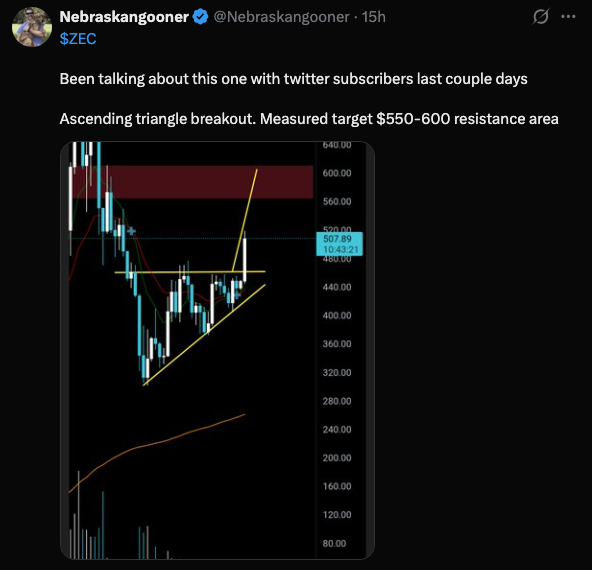
From a price structure perspective, technical analyst Nebraskangooner has recently highlighted ZEC’s formation of an ascending triangle on the daily timeframe. In his recent analysis on X, he identified a critical resistance zone between $550 and $600.
Is Zcash a Good Investment?
Whether Zcash is a good investment right now largely depends on an investor’s time horizon and risk tolerance.
From a fundamental standpoint, Zcash continues to benefit from renewed interest in privacy-focused assets, a mature and battle-tested network, and some positive Zcash news, that supports its long-term relevance within the crypto ecosystem.
On the technical side, Zcash remains in a structurally bullish trend despite the magnitude of this year’s rally. While indicators such as moving averages suggest continued strength, elevated momentum and nearby resistance levels also increase the likelihood of consolidation or short-term pullbacks. For traders, this means timing and risk management matter more than chasing momentum. For longer-term holders, periods of cooling may offer more attractive entry points.